
Marketplace Software Comparison
Best Marketplace Software 2026
An honest comparison of the top marketplace platforms. Find out which one is right for your business — whether you're validating an idea or scaling to millions.
Watch the Full Breakdown
14-minute guide to the 4 categories of marketplace software
Read the full video transcript▼
Why marketplace software is confusing (0:00)
If you search for marketplace software, you'll see tons of tools and tons of opinions on what is best and what is not good. And it's honestly quite confusing. But here's the truth: most marketplace founders, if they fail, they don't fail because they picked the wrong tool. They fail because they picked a tool that makes them build the wrong thing too slowly, and they never reach the moment that actually matters - getting real transactions.
In this video, I'll compare the main types of marketplace software out there, the pros and the cons, and I'll give you a framework so you can choose the right option for your marketplace idea. Let's do it.
Hi, I'm Rasmus. I've built multiple marketplaces, I've tested different approaches, and I've seen what breaks when you try to scale. And after doing this a few times, I realized something: marketplace founders don't need more freedom. They actually need fewer wrong decisions. So today I'll show you the marketplace software landscape, and what I would choose depending on your situation.
Marketplace software isn't one thing (0:55)
The reason this topic is kind of confusing is because marketplace software can mean totally different things. Some people mean: how do I launch a marketplace fast? Others mean: how do I handle payments and payouts to sellers? And it could also mean: how do I build an Airbnb, Etsy, Fiverr, or eBay kind of marketplace.
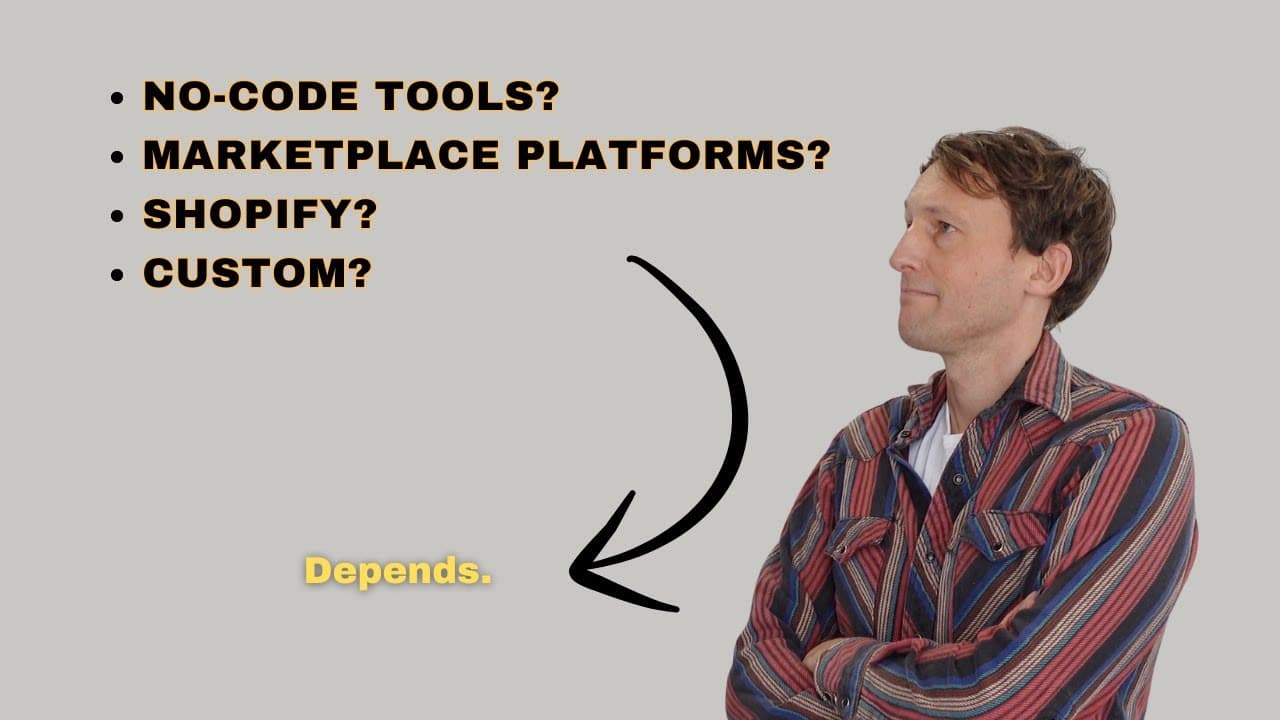
That's why, instead of ranking random tools from 1 to 10, I'm going to break everything down into four categories. After going through everything, you'll know exactly what category you fit into. The four categories are marketplace platforms, no-code tools, ecommerce stacks, and custom builds. And here's the key: every category has its upsides and its downsides.
The 4 marketplace software categories (1:25)
Marketplace platforms. These are platforms designed specifically for building marketplaces - not just websites. They come with the core flows you always need: seller onboarding, listings, transactions, admin tools, and a clear path to launching. Examples are Sharetribe, Arcadier, and of course my marketplace builder, Prometora. The biggest advantage is speed and momentum - not the speed of building landing pages, but speed to real first transactions. The downside is you can't customize everything, because the platform guides you toward first transactions. That can be exactly what you want if your goal is momentum.
No-code tools. This whole category is interesting because no-code tools can feel like the answer - “it's no-code, I can build anything fast.” Examples are Webflow, Bubble, Softr, and Bolt. No-code is usually good for prototyping, proof-of-concept demos, collecting leads, or validating interest. But here's the danger zone: marketplaces are not just pages and buttons. Marketplaces are workflows - sellers and buyers, payments, approvals, disputes, payouts, messaging, refunds. Things become complex very fast. No-code tools usually feel fast until you hit your first edge case. And marketplaces generate edge cases on day one.
Ecommerce stacks like Shopify can be a good solution for some specific marketplaces. If your marketplace is multi-vendor product listings, fixed pricing, and a standard ecommerce checkout, Shopify is a good fit. But if your marketplace is services, bookings, rentals, messaging-first flows, or approval workflows, Shopify turns into a pain with a lot of workarounds. Shopify works when your marketplace behaves like an ecommerce store.
Custom builds. What people imagine when they want maximum flexibility. Build with a dev agency, your own dev team, or a boilerplate like SpeedBuildMarketplace (for technical people getting going faster without starting from zero). The advantage is flexibility - any workflow you want. The downside is cost: time, money, complexity, decision overload - you do everything yourself. This is where a lot of technical founders get stuck in building mode, focusing on the next feature and the next feature, without ever launching and getting their first transaction.
How to choose the right marketplace software - 5 questions (4:57)
1. What are you selling? A product marketplace has a simpler, ecommerce-like flow. A service marketplace is all about trust, messaging, and approvals. A rental marketplace is all about availability, deposits, rules, damage handling. If you don't answer this first, you'll pick the wrong software.
2. Who collects money, and who gets paid? This is where marketplaces become real businesses. If you need seller payouts, you have to manage platform fees, seller earnings, transaction fees, refunds, and disputes. The moment you need payouts to sellers, you're not building a website - you're building a financial workflow.
3. Trust mechanics. Marketplaces don't win because of features. They win because of trust. Do you need verifications, reviews, messaging before payments, moderation, dispute resolution? The more trust complexity you have, the more you want marketplace software that understands it.
4. How fast do you want to launch? Speed isn't convenience - it's survival. Freedom feels like the goal, but freedom creates delays. Launch in weeks → guided marketplace software. Fine with months → custom-built.
5. Are you validating, or are you optimizing? This is the most important one. Validation means “will people pay for this?” Optimizing means “how do I improve what already works?” Validation is not about building. It's about getting paid. That's when you've really validated there's something there.
Marketplace revenue calculator demo (7:50)
There's one more thing nobody talks about when choosing marketplace software: the marketplace math. Founders get excited about features but haven't thought about the math. That's why I built a revenue calculator - put in your commission rate, average order value, and monthly orders, and it shows your break-even point, monthly and yearly net revenue, and what happens as you scale.
Quick-start example with Airbnb: 12% commission, $150 average order value, 90 monthly orders, on Prometora's Professional plan with a 1.5% transaction fee. Break-even is 6 orders. Per order: $18 commission, minus about $2 fee, net profit $16. Seller receives $125. Monthly: $13,500 GMV, $1,620 commission, ~$1,300 net monthly revenue, 9.8% profit margin. Yearly: around $15,000. At 200 monthly orders: ~$3,000/month, $36,000/year.
You can also put in custom numbers. Example: 17% commission, $85 average order value, 50 monthly orders on the Business plan - break-even at 12 orders, $14 per order, ~$521/month. At 100 orders, ~$1,200/month. The point is that this changes how you make decisions. If your marketplace needs 500 orders/month to survive, you need speed and momentum, not endless customization.
My recommendations based on your situation (11:26)
If you want to launch fast, get real transactions, and avoid wasting months → guided marketplace platform.
If you're still testing ideas, building prototypes, or collecting leads → no-code platform. Just don't confuse a prototype with a real marketplace business.
If your marketplace behaves like an ecommerce store (standard products, fixed pricing, standard checkout) → ecommerce stack like Shopify.
If you're technical and want full control → custom-built. A boilerplate like SpeedBuildMarketplace can save a lot of time.
Why I built Prometora (15:30)
Prometora comes from the mistakes I've seen marketplace founders make again and again. Most don't fail because they can't build. They fail because they build the wrong thing too slowly, with too much freedom. They spend weeks choosing layouts, filters, features, and edge cases. It feels like progress, but they never get to the one thing that matters: real transactions.
Prometora is not a framework. It's not a generic no-code tool. It's not a build-anything platform. Prometora exists to reduce the risk, time, and uncertainty of launching a marketplace and scaling it - always keeping the founder focused and moving toward more revenue.
Who Prometora is for, and not for (17:10)
Prometora is for you if: you're a serious founder, you want to validate and launch fast, you want a guided structure, and you want to be able to scale without rebuilding everything.
Prometora is not for you if: you want full control over every pixel, a developer playground, endless configurations, or to spend months customizing before getting your first users. This isn't a weakness - it's intentional. Prometora wins when marketplace founders get their first real transactions, not when they finish their setup.
Final advice and next steps (18:40)
That's it for this one. I hope it gave you an overview of the marketplace software map out there. Comment your marketplace idea below and I'll reply with the category I think you should choose. And check out the revenue calculator - link in the description.
The Marketplace Software Map
Four Types of Marketplace Software
"Marketplace software" can mean totally different things. Instead of ranking random tools, here are the four categories — each is good at something, and each has a trap.
Marketplace Platforms
Guided + Structured
Tools designed specifically for building marketplaces — not just websites. They come with core flows you need: seller onboarding, listings, transactions, admin tools, and a clear path to launching.
Examples
Advantage
Speed — not just 'I built a landing page' speed, but speed to real transactions.
The Trap
Not meant to be a 'build anything' playground. They give you proven defaults and don't let you endlessly customize everything.
"That can be exactly what you want if your goal is momentum."
No-Code Tools
Flexible, but risky
Tools that let you build without coding — from visual builders like Bubble to AI app builders like Lovable and Bolt. They feel like the perfect answer: 'I can build fast, and I can build anything.'
Examples
Advantage
Flexibility to build almost anything without developers.
The Trap
Marketplaces are not just pages and buttons — marketplaces are workflows. Once you have sellers, buyers, payments, approvals, disputes, payouts, messaging, refunds... things become complex extremely fast. Tools like Lovable can generate code quickly, but you'll still need to debug and maintain it when edge cases appear.
"No-code feels fast… until your first real edge case. And marketplaces generate edge cases on day one."
Deep dive: No-code marketplace builder →Ecommerce Stacks
Shopify + Apps
Platforms like Shopify with multi-vendor apps. A good option for specific marketplace types where the model is essentially ecommerce with multiple sellers.
Examples
Advantage
Mature ecosystem, proven at scale, familiar checkout experience.
The Trap
If your marketplace needs bookings, rentals, messaging-first flows, or approval workflows, Shopify turns into a patchwork of apps and workarounds.
"Shopify works best when your marketplace behaves like a store."
Deep dive: Ecommerce marketplace (how to build one like eBay) →Custom Builds
From scratch or boilerplate
Building with a dev agency, your own team, or using a marketplace boilerplate. Maximum flexibility and ownership.
Examples
Advantage
Ownership and flexibility — you can build any workflow.
The Trap
Cost: time, money, complexity, decision overload. This is where founders accidentally get stuck in building mode for months before a single transaction happens.
"Great if you're technical, but validation should come before months of development."
Platform Comparison
Leading Platforms Compared
The top platforms across categories — who they're best for
Prometora
Guided launch, built to scale
Best for: Non-technical founders who want a guided approach to validate, launch, and scale
From $99/mo (live)
Live marketplace from day one
Sharetribe
Flexible marketplace framework
Best for: Teams with developers who want full control
From $99/mo (annual)
$99/mo requires annual billing ($139/mo monthly). 50 free transactions, then $0.19 each
Arcadier
Enterprise marketplace platform
Best for: Mid-size businesses with budget for customization
From $299/mo
Enterprise pricing varies
CS-Cart Multi-Vendor
Self-hosted marketplace solution
Best for: Technical teams who want to own their infrastructure
From $1,450 one-time
Plus hosting & maintenance
Marketplacer
Enterprise marketplace infrastructure
Best for: Large enterprises and retailers
Custom pricing
Typically $50k+/year
Feature Comparison
Side-by-side comparison of key features
| Feature | Prometora | Sharetribe | Arcadier | CS-Cart | Marketplacer |
|---|---|---|---|---|---|
| Getting Started | |||||
| No-code setup | Partial | ||||
| AI-powered content generation | |||||
| Guided launch workflow | Partial | ||||
| Time to launch | Days | Weeks-Months | Weeks | Months | Months |
| Core Features | |||||
| Multi-vendor support | |||||
| Built-in payments (Stripe) | Partial | ||||
| Commission management | |||||
| Reviews & ratings | |||||
| Messaging system | |||||
| Custom domains | |||||
| Flexibility & Customization | |||||
| Visual editor | Partial | Partial | |||
| Custom code access | Roadmap | Partial | |||
| White-label branding | |||||
| Self-hosting option | |||||
| Growth & Scale | |||||
| Built-in analytics | |||||
| SEO tools | |||||
| API access | Business plan | ||||
| Webhooks | Business plan | ||||
Platform Deep Dives
Detailed breakdown of each platform's strengths and weaknesses
Prometora is built for non-technical founders who want a guided approach to validate, launch, and scale their marketplace. Instead of giving you a blank canvas, Prometora guides you through a structured process with AI assistance — from your first listing to scaling with real transactions.
Pros
- Guided workflow from validation to scale
- Fastest time to launch (days, not months)
- AI generates pages, content, and listings
- No technical skills required
- Affordable starting price ($99/mo)
- Built to grow with your marketplace
Cons
- Less flexibility than developer-focused tools
- No self-hosting option
- API access only on higher plans
- Newer platform (less market presence)
Ideal for: Solo founders and first-time marketplace builders who want a guided path from idea to scale
Find Your Fit
Which Platform Should You Choose?
Now that you know the categories, let's find the right platform for your situation. Answer 4 quick questions.
Do you have developers on your team?
Marketplace Math
Calculate Your Marketplace Revenue
Most founders get excited about features but don't know what their marketplace will actually earn. Plug in your numbers to see your break-even point, monthly revenue, and how it scales.
Your Settings
Break-Even Analysis
Orders to Break Even
36
GMV at Break Even
$1,800
You're 64 orders above break-even! Your subscription is covered.
Net profit per order: $4 (your 10% commission minus 1.5% Prometora fee)
Per Transaction Breakdown
Deducted from seller
What you earn as marketplace owner
Seller side (for reference)
Monthly Projections
Yearly Projections
Revenue Growth Chart
Visualize how your net revenue scales with order volume
Monthly orders → Net revenue/month
Scaling Projections
See how your revenue grows as your marketplace scales (based on $50 AOV, 10% commission, Professional plan)
| Orders | GMV | Commission | Fees | Net |
|---|---|---|---|---|
| 50 | $2,500 | $250 | -$187 | $64 |
| 100Current | $5,000 | $500 | -$224 | $276 |
| 250 | $12,500 | $1,250 | -$337 | $914 |
| 500 | $25,000 | $2,500 | -$524 | $1,976 |
| 1,000 | $50,000 | $5,000 | -$899 | $4,101 |
Ready to Start Earning?
With 100 orders at $50 AOV, you could be earning $276/month. Start building your marketplace today.
Trusted by Marketplace Founders
“I had been thinking about building a marketplace for some time and already tried several ‘no coding’ platforms. These however were too restrictive in customization for my needs. After looking for alternatives I stumbled upon Prometora and can honestly say I never looked further since. Customization is great and a lot of features are already present for different types of marketplaces. Above all that the customer support is superb which really makes this one of the best ‘no coding’ platforms. I would highly recommend Prometora for anyone trying to build a solid marketplace with very basic technical skills.”
Lukas V.
Founder, United Spares — Automotive parts marketplace
“We had been looking for a platform for our jewelry marketplace for a long time, but most solutions were either too technical or lacked important features. With Prometora we quickly built a professional marketplace with Stripe payments, seller onboarding, and our own domain - without writing a single line of code. The support has been fantastic and always quick to help. Highly recommend Prometora to anyone wanting to start a marketplace.”
Julius J.
Founder, Valé — Jewelry marketplace
“I wanted a reliable partner, and choosing Prometora was undoubtedly the best decision for developing Perigoodies. The team’s guidance and dedication made my job much easier, and their responsiveness and support far exceeded my expectations and are greatly appreciated.”
Nelly P.
Founder, Perigoodies — Périgord artisan & gourmet marketplace
Frequently Asked Questions
Sharetribe Go is another option, but it's more limited in customization. See the full Prometora vs Sharetribe comparison →
• Prometora: $99-249/month (or $3,999 one-time White Glove setup for done-for-you launch)
• Sharetribe: $99/mo, but Flex customization can cost $10k-50k+ in development
• CS-Cart: $1,450+ one-time, plus hosting and maintenance
• Marketplacer: Typically $50k+/year
However, if you want deep customization or unique features, you'll eventually need technical help. The question is whether you need that before or after validating your idea.
• 0 to first transactions: Prometora is optimized for speed
• Proven traction needing custom features: Sharetribe Flex or CS-Cart
• Enterprise scale: Marketplacer is purpose-built
Whichever platform you pick, the harder problem is usually the chicken-and-egg problem — getting supply and demand at the same time. Weighing Prometora against Sharetribe specifically? Read the detailed side-by-side comparison →
Custom development costs $50k-200k+ and takes 6-12 months. Use marketplace software to validate your idea first, get real users, and prove the business model.
If you're still at the idea stage, start with how to start an online marketplace before picking any platform. You can always migrate to custom later with real revenue.
Most platforms allow data export. The challenge is rebuilding your marketplace on the new platform, migrating users, and maintaining SEO.
It's easier if you plan for potential migration from the start.
Prometora charges 1-2% depending on plan. Sharetribe charges based on transaction volume.
Most platforms use Stripe Connect for marketplaces, which adds its own processing fees on top. Always factor in total cost including subscription, transaction fees, and development costs. Try the calculator above →

Ready to Launch Your Marketplace?
Stop comparing. Start building. With Prometora, you can have a real marketplace live in days — not months.
Start Free Trial14-day free trial. No charge until your trial ends.